
Discussion thread | What do you (need) to study successfully?
“The social model versus the medical model.“
Introduction
This discussion guide offers a critical reflection on the current approach to support for students with support needs in college/university education. It addresses the difference between the medical model and the social model of disability. It focuses on the question “What do you need?” rather than “What do you have?” The guide challenges education professionals to think about how to encourage students to indicate what accommodations will best help them study successfully, rather than focusing on a medical diagnosis. It also offers insight into the need for an inclusive approach in education, supported by the United Nations Convention on the Rights of Persons with Disabilities, and emphasizes the importance of adapting education to students’ needs, not the other way around.
Target
The discussion guide is intended for education professionals in the college/university of applied sciences, including CvB members, teachers, student deans, members of examination committees, and support services staff. It is also aimed at policymakers and others responsible for supporting students with support needs. It offers insights for anyone involved in improving accessibility and inclusivity in the college/university of applied sciences, with a focus on supporting students who face study barriers due to a support need.
Target
This discussion guide helps you as an education professional think about how best to support students with disabilities during their studies. The guide provides tools for having conversations about how to adapt your approach from the medical model to the social model of disability.
By focusing on what students need to study successfully, rather than what they “have,” this guide encourages a more inclusive and accessible learning environment. The goal is to start a constructive discussion about how we as educational institutions can remove barriers for students and help them reach their full potential.
Question: what do you have?
Focus on limitation
In a conversation about facilities with a student, the question “What do you have?”, or asking a student about his or her disability or chronic illness, seems relevant and obvious. Consequently, students are often asked this question. Thereby, in order to claim facilities, the student is required to provide a medical certificate or dyslexia statement. This proves that the disability has been formally diagnosed by a recognized medical authority. However, differing (functional) limitations lead to the same study obstacles. It is therefore interesting to look for the reasons behind this question. And what consequences the answer has.
The question behind the question
Why is a student asked to formally demonstrate “what he has”?
- Is it a matter of imaging, to be able to create a clear profile of the student and be able to categorize them?
- Is it a form of “thinking for the student,” whether from a moral judgment or not: “Tell me what you have, and I’ll know what’s good for you”?
- Is the key person (the questioner) able to provide appropriate accommodations based on their knowledge of the student’s disability?
- Is there a policy or protocol based on a direct relationship between what you have, and what you need? Such as: by definition, a student with dyslexia gets an extra half hour of exam time.
- Does it stem from the fear that otherwise “everyone” will start using facilities?
- Is it the student’s expectation? “I tell what I have, then I get what I need.”
- Are there any other reasons?
The question: what do you need?
Focus on study barriers
Opposite the focus on limitations is the focus on obstacles. Many educational institutions and ECIO focus in vision and activities on the study obstacles that students with disabilities experience while studying at a college or university.
The basic assumption here is that study obstacles can be compensated for by (reasonable) adjustments and facilities, such as extra time, (digital) aids and extra manpower for guidance, training and support.
People work of key people
Preventing or reducing the impact of the study obstacle on the student’s study success is by definition people work.
Key figures within the institution as well as the student himself play a key role in this. These key figures are the student counselors, who together with the student identify what facilities he or she needs. In addition, the study (career) counselors, teachers, members of examination committees, policy officers, managers, information officers and administrators give hands and feet to these facilities.
Asking for the need
If you approach a student about the barriers to study he or she is experiencing, you are essentially asking these questions:
- As a student (with a disability), what do you need?
- What can we, as education, change/adapt about our methods, procedures or organization that will allow you as a student (with a disability) to study and participate?
Relationship between the questions and scientific models
The context
CIO supports stakeholders, or key figures, in their responsibility for, involvement in and vision of the implementation of the policy ‘Studying with a disability’ within each college and university. The ultimate goal in mind is the development of future-proof inclusive college/university.
The common frameworks of cooperation between ECIO and key figures in higher education are formed by established laws and regulations, such as the Equal Treatment on the Basis of Disability and Chronic Illness Act (WGBh/cz), the Higher Education and Scientific Research Act (HRA), the UN Convention on Persons with Disabilities.
In addition, the seven Maatstaf themes (Making More Possible, Studying with a Functional Disability in Higher Education. Advies van de Commissie Maatstaf i.o.v. OCW, 2010.) and the policy of the Ministry of Education, Culture and Science for appropriate and inclusive (higher) education are leading. Educational principles such as Universal Design for Learning and scientific models also determine these frameworks. Although multiple scientific models are used to “look” at disabilities, in this article we limit ourselves to the medical model and the social model.
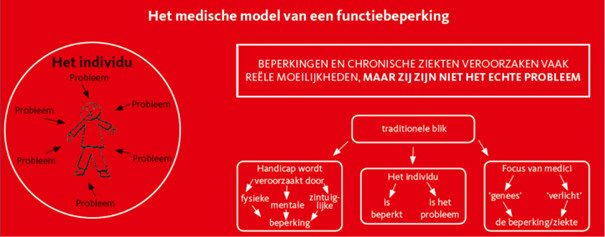
Medical model: what’s wrong with you?
The medical model puts “the problem” on the individual (the student with a disability).
If you follow this model strictly, the medical profession gets (or keeps) an important responsibility for the participation of the student with a disability in education. Indeed, by doing so, the educational institution is essentially saying:
- the disability must be diagnosable and measurable by a medical authority, outside the school
- this diagnosis allows the student to use standard assistive devices to minimize disability (cf. the “diagnosis treatment combination” DBC)
- the quality of study is improved because with a simple additional tool, such as a pre-reading program
- or half an hour of additional exam time, the student’s functional limitation is compensated for and the student thereby
- can study as “normally” as possible, just like any other student.
This will have to be determined time and again, for each student individually. The advantage of this is that, as a key person, you don’t make “misses” because what the student claims is wrong is confirmed by a doctor/specialist. And this is done independently, outside the door. Granting the facility is legitimate on that basis and avoids doubts in, for example, the examination board.
Social model: what do you need?
The social model is about inclusion and the relationship between the person and his environment, society (the educational environment). Learning to cope with a disability/disability is not only the responsibility of the individual, of the student, but also that of society.
Read: that of the educational institution.
The UN Convention on Persons with Disabilities, also in force in the Netherlands since July 14, 2016, is actually based on the social model. Developments such as Appropriate Education and the Participation legislation also stem from this. From that vision, ECIO also looks at study barriers, and thus at the question, “What do you need? The environment has the responsibility to reduce, or preferably prevent, the impediment.
If a student reports that he/she is impeded in any way from studying, formulate the following questions:
- What “environment” (the building, the digital learning environment, the class schedule, the didactic form of work, the method of assessment and so on) causes the obstacle indicated by the student?
- Does the proposed adaptation or provision remove this barrier(In some cases, this is difficult to predict; the provision may then be granted temporarily at first, after which evaluation of the effect takes place.) and does it optimize the student’s learning conditions (thereby increasing the likelihood of success)? In other words, is the adjustment “necessary and appropriate”?
- Can this adaptation or provision be made a “standard” so that others can also benefit and obstacles in the future are avoided?
Reasoning from the social model, there is no utility or need for a medical certificate to prove entitlement to facilities. Obviously, no concessions are made to (the level of) competencies to be obtained.
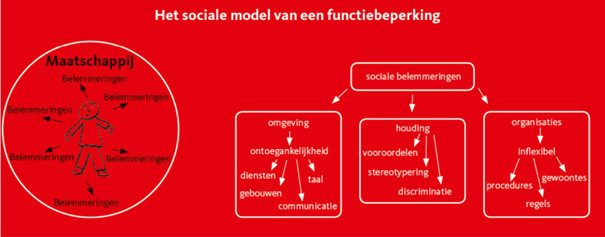
For educational professionals, it is not (yet) always clear from which point of view the obstacles that students with disabilities experience when studying should be looked at. If you use the medical model, the problem lies primarily with the student and you are expected to contribute to the solution of that problem by providing ‘facilities’. However, if you use the social model, then suddenly the problem lies with you. The emphasis is on preventing rather than solving problems.
What position do you take, as an educational institution and as an individual teacher? That discussion needs to take place and this article offers the necessary starting points and arguments to do so.
We hope to contribute herewith to the development of future-proof inclusive higher education and an increase in the participation of people with disabilities in both higher education and society as a whole.

