
Digital accessibility | HAN’s approach to education
“The implementation framework provides practical guidelines.”
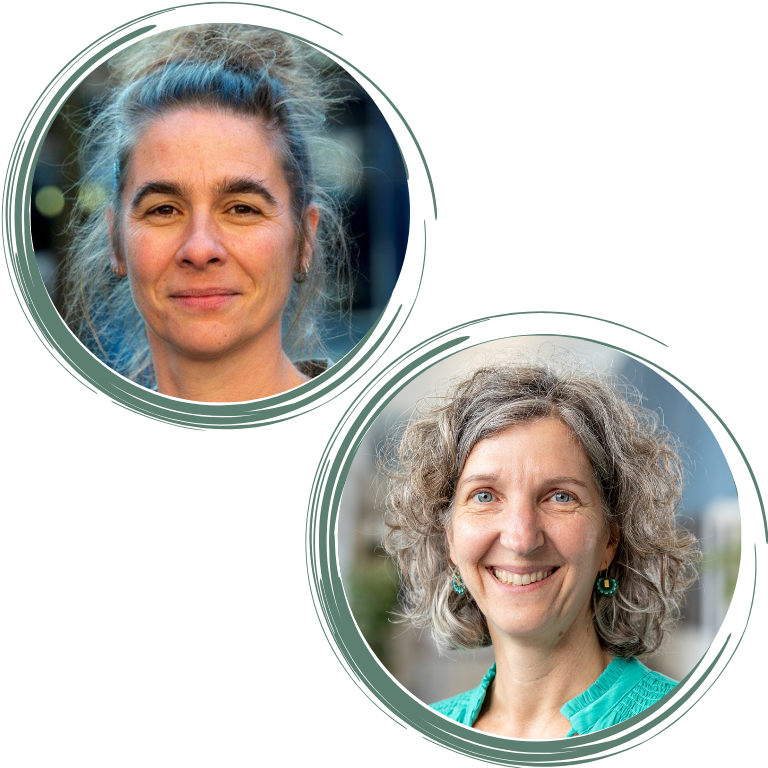
At HAN University of Applied sciences, inclusiveness is central to the educational approach. We spoke with policy advisors Astrid Sluis and Annemieke Peeters. Their focus is on student wellbeing in its broadest sense. In this article, we discuss how HAN is working towards an educational environment in which all students, regardless of their support needs, can develop optimally.
Policy level
UN Convention on Disability
In 2023, HAN signed the declaration of intent of the UN Convention on Disability. This commits the university to an inclusive education policy. “We are working on ever better (digital) accessibility of our education and the physical HAN environment so that more and more students can participate without barriers. Nevertheless, additional (customized) facilities will always be needed for individual students.
Course Plan
Inclusion and improved accessibility of education are also part of HAN’s institutional plan for 2022-2028, the Course Outline, in which the development of flexible education, data and digital skills as well as world citizenship are important objectives. The course outline also explicitly mentions points of attention such as accessible communication, awareness campaigns for employees and improving physical accessibility on campus.
Studying with special circumstances
The student well-being wheel, developed by students, staff and experts, is an HAN-wide action framework that shows the themes in which HAN wants to positively influence the well-being of its students.
For example, HAN is addressing the themes of “Customized support” and “Inclusive and safe college” among others in the policy development around studying with special circumstances that will be completed this spring. This policy follows the social model: the focus is not on the disability, but on removing obstacles for students. This happens in an interplay between the student, the (senior) student supervisor, examination committee, management and/or student guidance specialists.
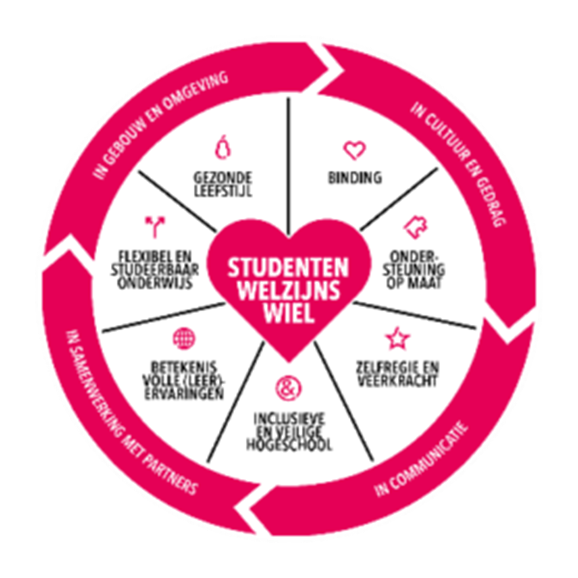
“The Student Welfare Wheel serves as a solid stepping stone for plan formulation and implementation” – Annemieke
Education level
Implementation framework for digital accessibility
Another important pillar for more inclusive education is the development of the Digital Accessibility Implementation Framework. This framework provides practical guidelines for executives, content developers, educational developers/executives, engineers and developers, and technology buyers. In doing so, it translates the Harvard approach to HAN for an institution-wide, sustainable approach. The implementation framework, launched in May, should ensure a more standardized way of working. Astrid emphasizes that the implementation of digital accessibility requires continued attention and that structural evaluations will be conducted to monitor progress.
Flexible education
Another important pillar is flexibility in education. Students are given more self-direction to make choices during their student pathways, for example choosing by pace or sequence. This allows them to connect to their personal situation. Does the student want to slow down or speed up? At HAN, they are giving this shape through ‘Educational offerings including choices’ and guidance for students in making these choices. Educational logistic processes are being standardized in order to subsequently become more flexible. This will eventually require less customization of educational facilities.
“It’s about making every student feel that they are allowed to be there – and that they are seen, heard and known” – Astrid
Tools and accessibility
HAN offers several useful tools, such as Claroread, that can be used for both tests and assignments, at home and at school. Employees use these as well. There are also tools such as SpeakSee, Novastar and Dragon, which students can request. For these tools, a number of licenses are available within HAN. In addition, Readspeaker is integrated into the digital testing platform ANS.
Integral approach
Digital Accessibility Expert Team
To realize inclusive ambitions, a multidisciplinary working group has been established. The Digital Accessibility Expert Team works with professionals from HRM, education and student policy, communication and ICT. Lecturer Eric Velleman is also involved. This working group works with colleagues and students who are working on realizing the course goals World Citizenship and Digi- and data-savvy students and professionals. They develop tools (such as a toolbox) and trainings and give advice, for example in the field of inclusive didactics and communication.
Lectureship of Inclusive Digital Design & Engineering
The lectureship Inclusive Digital Design & Engineering focuses on awareness and solutions for inclusive digital design and engineering. Together with Bartiméus and through co-creation with users, students, professionals and researchers, inclusion is promoted within HAN. Research projects focus, for example, on the development of user-friendly learning platforms and inclusive digital test forms.
Successful interplay
HAN can be proud of the enthusiasm of colleagues and spontaneous initiatives that make a difference for students. During the corona pandemic, for example, we were able to move quickly to realize real-time subtitling with SpeakSee. This project came about thanks to a special collaboration between students and teachers with hearing impairments. The multidisciplinary working group is also a wonderful example of commitment and motivation; it was spontaneously created on the shop floor.”
Through collaboration, innovation and an integrated approach from policy to practice and vice versa, HAN works to create an inclusive educational environment where every student has the opportunity to be successful.
Tips from the practice of Astrid and Annemieke
Share your knowledge and experiences?

