
Tool | Building blocks of flexible education with UDL
“Doing justice to each student’s need and talent.”
About the building blocks
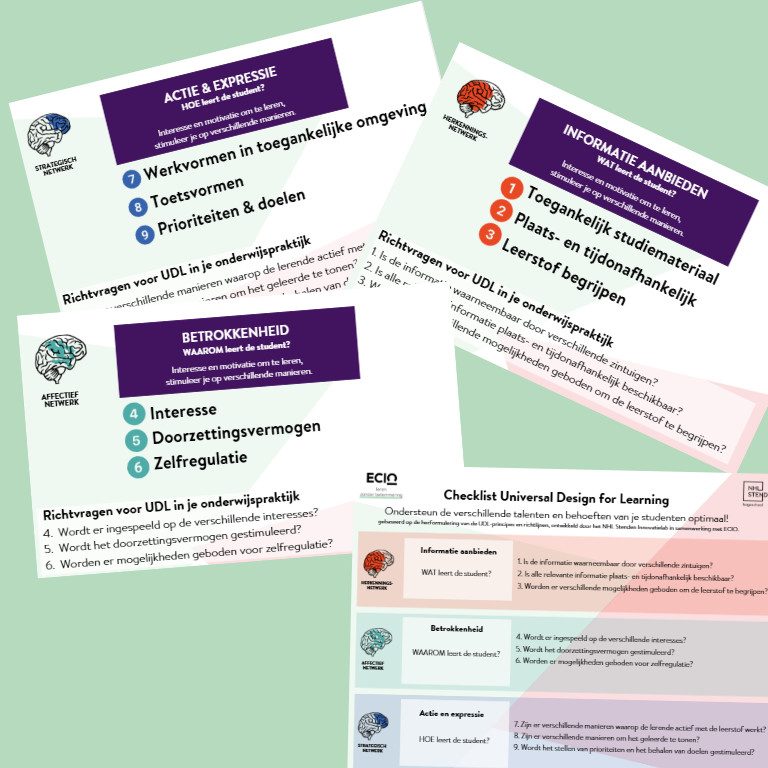
The building blocks help you design flexible education with Universal Design for Learning (UDL), where diversity is the starting point. This ensures that every student has the opportunity to learn optimally. Universal Design for Learning (UDL) provides a powerful framework for designing flexible education that does justice to the needs and talents of every student. The building blocks help you do this. These are based on the three brain networks that each have a defining function in learning: the recognition network, the strategic network and the affective network. The building blocks were created through collaboration with NHL Stenden Hogeschool and ECIO.
Who is it intended for?
The building blocks of Universal Design for Learning (UDL) are designed for teachers, educational developers and policy makers who want to make education more accessible and flexible. The model offers practical tools for designing lessons and curricula in such a way that all students can learn and participate optimally. UDL is also valuable for student supervisors and academic coaches because it provides insight into how to better support diversity in learning.
What do the building blocks offer?
The insights are translated into concrete building blocks to help you design flexible education. Each network gets specific attention in the tool, with practical examples and guidelines. Thus, we offer building blocks for:
- WHAT: inclusive learning materials and multiple representations of information.
- HOW: skill building, choice in processing assignments and use of technology.
- WHY: Stimulate motivation by personalizing learning objectives and promoting interaction.
With these building blocks, we provide valuable support to make flexible education accessible, effective and inspiring for all students. Flexibility thus becomes not a challenge but an opportunity to realize the maximum potential of every student.
The three brain networks and their role in learning
- The recognition network: WHAT the student learns. This network is responsible for recognizing and understanding information, ideas and concepts. It helps students make meaning of what they perceive, such as text, images or sounds. Support within this network focuses, for example, on variation in learning materials and accessible information presentation so that students can access the same content in different ways.
- The strategic network: HOW the student learns. This network controls the executive functions of the brain and plays a role in planning, executing and controlling tasks. It helps students develop strategies and deploy skills to learn effectively. Flexible learning provides support here through adaptable learning paths and choice in ways to achieve their learning goals.
- The affective network: WHY the student learnsMotivation and engagement stem from the affective network. This network evaluates experiences and determines priorities, where emotional charge and intrinsic motivation play a role. The flexible design of education here requires attention to variety in learning activities, freedom of choice and connection to students’ personal interests and goals.
Discover the building blocks and deploy UDL to enable flexible education for all students!

