
Self-scan UN disability convention VET/HPE/UE
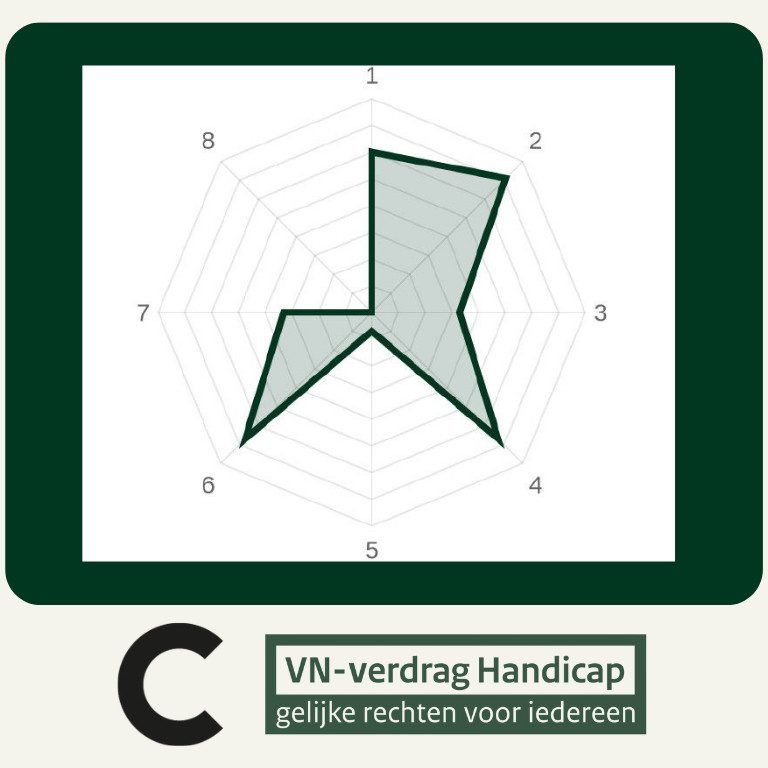
“Step-by-step implementation UN disability convention in education.”
About the self scan
With the redeveloped UN Convention on Disability Self-Scan for vocational colleges, universities and universities, which is currently in the pilot phase, you can get actively involved in inclusive education. This tool supports VET, HPE and UE institutions in making the goals of the UN Convention concrete and applicable in policy, education and organization. Using eight fundamental elements of inclusive education, you will gain insight into where your institution is now and where there are opportunities for further growth.
You complete the self-scan step by step, together with colleagues from different roles. This is how you start the conversation about inclusion based on shared insights. There is no right or wrong: the self-scan is not an assessment, but a joint exploration. Precisely because the self-scan is in development, you contribute your experiences to further improve it. This is how you work together for more inclusive education and for a more inclusive society.
Students with support needs
The self-scan focuses on students with support needs. These are students who experience barriers during their studies, for example, due to a functional disability, chronic illness, mental health issues, pregnancy, young parenthood, trans- or gender-diverse students or special family circumstances such as informal care.
Who is it intended for?
The self-scan is for all professionals in VET, HPE and UE who are involved in the design of inclusive education. Think of employees from all levels within the educational institution, such as policy officers, teachers, study advisors, deans, ICT employees, facility services, examination committees and so on. Would you, as an educational institution, like to sign the declaration of intent soon? Then please contact us.
Condition
Educational institutions that have signed the UN treaty declaration of intent, or intend to do so soon, can get started with the UN treaty self-scan for mbo, hbo and wo with a special code.
Elements of inclusive education
Eight elements are fundamental in shaping inclusive education and translating the UN Convention into practice. Here we distinguish the following elements with their corresponding aspects:
- Education system: governance, policy and agenda setting – UN treaty compliance – quality assurance – student participation
- Learning environment & culture: physical accessibility – digital accessibility – sense of belonging – social safety – prevention and early detection
- Program & testing: flexible learning pathways – including testing and examining – UN Convention on Disability in curriculum
- Support offerings: guidance and facilities – communication and information provision
- Equipping professionals: welfare teaching staff – training
- Transition to and from education: transfer secundary (special) education/VET to HPE/UE- internships – transition labor market
- National & regional cooperation: national knowledge exchange – cooperation with external guidance chain (GGZ and municipality) – stakeholder involvement (regional and national level)
- Monitoring & data use: data science – monitoring – quality assurance
Click on an element below to learn more about related aspects.
Frequently Asked Questions
Below are answers to frequently asked questions about completing the UNCRPD mbo/hbo/wo self-scan. Please read these carefully before you start.

