
Student experience | Anniek on her internship abroad with cerebral palsy
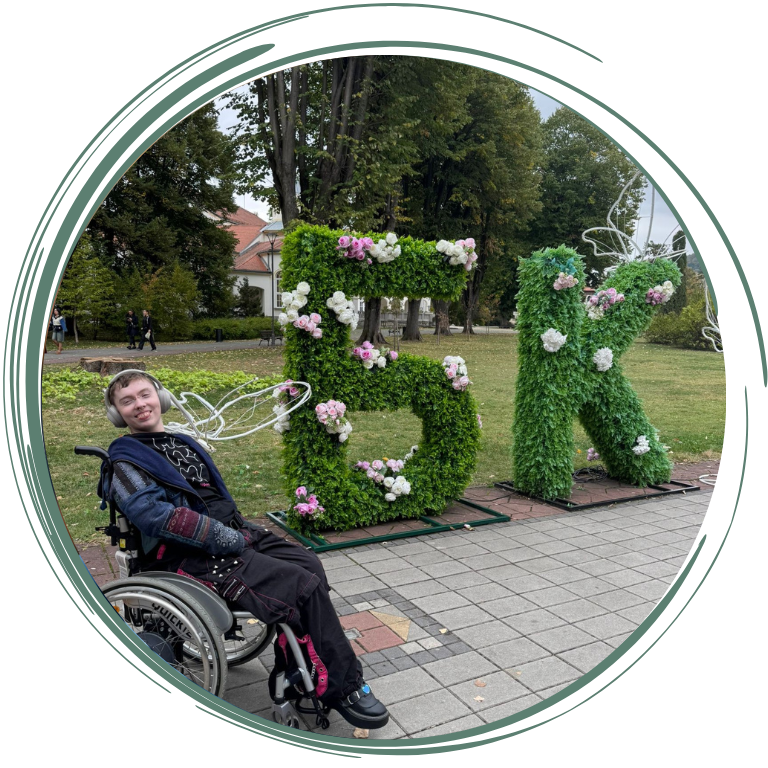
“You are not your disability – you HAVE one.”
Guts, independence and learning outside the comfort zone | Anniek Noort, fourth-year Game Art student at Mediacollege Amsterdam, has a mission: to show that you can do more with a disability than is often thought. She has cerebral palsy and ADHD, which makes her motor skills work in one hand, but when working on her computer she is completely self-reliant. This year she left for Serbia for an internship teaching workshops to students with disabilities: “Everyone can do something. Just not everyone gets that opportunity.”
A dream that pushes boundaries
Anniek Noort grew up with art, culture and curiosity. “My mother took me everywhere, that made me eager to learn.” When a teacher put her in touch with an internship company in Serbia, she took her chance: “I wanted to see what it’s really like, not just on vacation, but working and learning among the people there.”
“Many people said: Serbia? That’s not smart, is it? But I thought: I’ll see. If it doesn’t work out, I’ll go home again.”
Her internship runs from September 2025 to February 2026, with a stop at home for Christmas. In Serbia, Anniek gives workshops to students with disabilities. “We look together at what you can do and how to find work that fits with that. They have difficulty asking for help, but if you are physically present, it makes it easier for them. Worldwide, many people with disabilities are told, ‘You can’t do anything.’ That touched me. Everyone can do something, sometimes someone just has to show you that.”
Accessibility begins with creative thinking
As it turned out, Serbia was not exactly wheelchair-friendly. “It’s mountainous, wheelchair cabs don’t exist, and public transportation is limited. Fortunately, my mother arranged for a car, and my nurses drive me everywhere. Sometimes it’s a 20-minute drive, sometimes a four-hour drive. The first week was tough. Wrong bed, wrong facilities, I was crying on the phone with my father. He said, “Don’t whine, fix it. So I did. Within half an hour I had arranged a new mattress through a nursing home. That felt like a victory.
“You learn that you can do more than you think.”
Self-reliance as a lesson
“At home you are helped quickly. Here I have to do things myself. I can’t be lazy, I have to do things. And that feels good. My parents support me in everything, but this was also an exercise in letting go for them.” That independence suits her way of thinking: solution-oriented and with humor. “I see so many people who say, ‘I have a disability, so I can’t do anything.’ No! You are not your disability, you have one. That’s something completely different.”
Practical arrangements: from care to airline tickets
An internship abroad with a disability requires extra preparation. Anniek arranged her own funding with a scholarship from Erasmus+ through her school and a contribution from the VSB Fund, because Serbia is outside the EU. She also arranged her care and transportation on her own initiative.
“I called KLM numerous times for medical assistance. Three days before departure I got the confirmation: everything was arranged, paramedics would help me on board. It went perfectly well.”
Anniek receives 24-hour care from a hospital in Serbia: three nurses who take turns helping. “That gives peace of mind. But it’s still puzzling: from transportation to communication. I speak a little English, German and learn Serbian from what I hear. Sometimes a word I checked turned out to be a swear word,” she laughs.
Culture shock and heat
The cultural differences are great, but Anniek quickly found her niche. “Serbian people seem surly, but when you talk to them they are so sweet. The owners of my Airbnb now call me ‘their daughter from another country.’ They took me to church. I didn’t understand any of it, but it was nice to see how important faith and community are here.”
What could be better: “Protecting is not helping”
Not everything went smoothly. “From school I got support, but there was also doubt. ‘Isn’t Serbia too far? Maybe better Belgium or Germany?’ They mean well, but sometimes you get too protected. Just let me try.” Cooperation with the internship company was through her teacher. “He arranged a lot behind the scenes, but I preferred to communicate myself. In the end everything went well, but it required constant switching. Without him it wouldn’t have worked out. But I would have liked to have had more control of my own.”
Looking to the future
After Serbia, the adventure tastes like more. “I might want to go to Sweden. Not right away, I need to recharge first. But I want to see how other countries deal with people with disabilities. In the Netherlands I get stuck in rules. You are not allowed to work with a Wajong, otherwise you are ‘not disabled enough’. In other countries they do this differently. I want to experience that, so I can improve it here.”
“Eventually I want to go to the House of Representatives and tell them how things can be done better. Because I’ve seen it, and I know it can be done differently.”
And perhaps her most important message:
“If something doesn’t fit in the box, just reinvent that box so it fits around you.”

