
Educational approach | Tilburg University on neuro-inclusive testing
“What’s good for neurodivergent students is often just good teaching.”
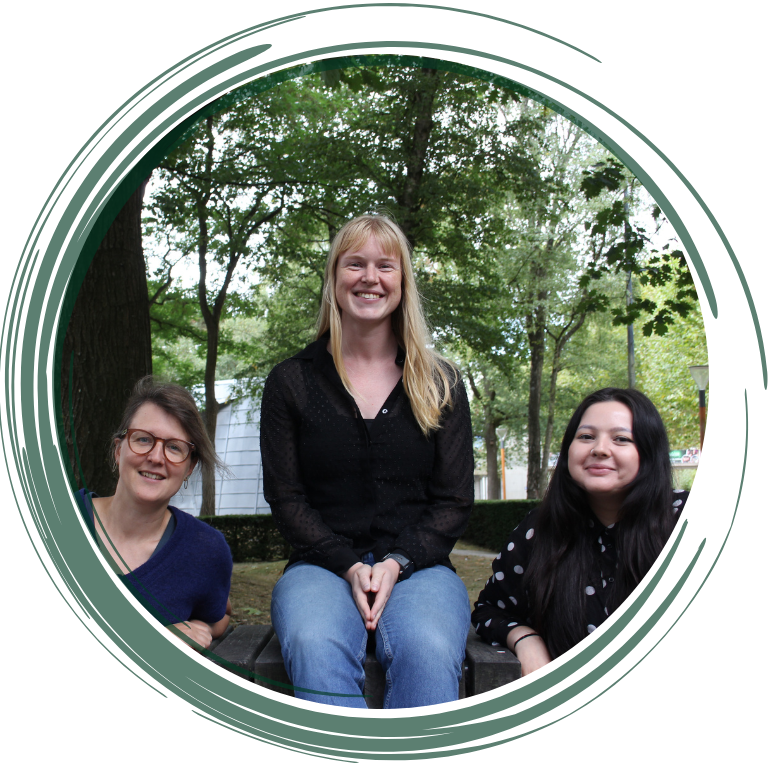
Who decides what constitutes “good presentation”? Many evaluation criteria focus on making eye contact, good nonverbal posture, enthusiasm, variation in voice use. But don’t such criteria actually exclude students? In the Bachelor of Philosophy at Tilburg University, lecturers dared to question this and developed a more neuro-inclusive approach to practicing and assessing presentation skills. We talked to Hanne Jacobs (program director), Yvette Drissen (lecturer) and Sinsemilla Blokvoort (former student assistant) about this approach.
What prompted your neuro-inclusive innovation?
Yvette: “It started with student feedback. One student came to me asking if she would lose points on her monotone voice, because the grading rubric stated that voice variation was expected. Another student talked about fearing panic attacks during presentations. Yet another had tics that they worried about during grading. Those concerns were the starting point for me.”
Hanne: “The program’s final requirements state that philosophy graduates should be able to present philosophical concepts and arguments. But nowhere does it say exactly what ‘good presentation’ means. When I looked at the assessment rubric, I saw how prescriptive it actually was: eye contact, voice variation, body language, et cetera. But what if someone stutters, is in a wheelchair, or is neurodivergent? Then they were actually being judged on something that doesn’t necessarily say anything about the content quality of the presentation or the effectiveness of the presentation. Moreover, because this was a first-year course that counted toward binding study advice, it became especially urgent to review it.”
Normative assumptions in the assessment rubric: what did that mean for you?
Hanne: “To me, it felt like that assessment rubric was really stuck in some kind of idée fixe. The way students had to present was presented as a matter of course, but of course it wasn’t. Eye contact, hand gestures, voice variation, as if that universally meant ‘good presentation.’ I wanted to fundamentally challenge and modify that. In the end, what we want is: authenticity. We want to give students the space to find their own convincing way of presenting, a way that suits them.”
Sinsemilla: “What you also see is that current assessment criteria are often neuronormative. There is a certain idea of what a ‘good speaker’ or a ‘good presentation’ is, for example, someone who uses their hands, is enthusiastic, looks at people. But that’s just one style. And so that structurally excludes certain students, without saying anything about their ability to deliver a message effectively. This is actually never in question. We actually wanted to question that normativity.”
How did you proceed?
Sinsemilla: “We started with a literature review. Hanne had already collected a lot of literature, and I was working on my thesis on autism and epistemic injustice myself. That dovetailed nicely. We combined those insights with practical and experiential knowledge. While reading, I got many ideas about how things could be done differently. I worked those out and then we presented them to students through focus groups. Students could also provide input one-on-one or in writing, just what was comfortable for them.”
Hanne: “For me it was important to delve deeper, precisely because I am not an educationalist. One sentence from an article has always stayed with me: ‘Neuro-inclusive assessment design, bears a strong resemblance to good assessment.’ That felt like a key sentence. What is good for neurodivergent students is often just good teaching. We wanted to take that seriously and also start substantiating it empirically. Not on gut feeling, but through conversations with students, focus groups and further research.”
How did you create support?
Hanne: “We deliberately did preparatory work. We invited two outside philosophers for a theoretical lecture on neurodiversity for teachers and staff members. A little later, we pitched our innovation to that same group. In doing so, we gave simple tips (such as: number your slides, think about recordings). We also shared this outside the department in workshops and in consultations with program directors. That way we really built support. Was everyone immediately converted? No. But there is now widespread awareness that this is an important issue, and colleagues know where to find us.
What also helps: there are employees who are openly neurodivergent or have personal experiences. That lowers the threshold for conversation and nuances stereotypes. Often teachers are quite willing to learn, but above all they need tools.”
What did the assignment look like before, and what does it look like now after your modifications?
Yvette: “Previously, in a first-year course, students were given a long philosophical text and had to give a 30-minute presentation. There was hardly any practice or guidance in it. You immediately jumped into the deep end and it became mostly a snapshot. In the updated version, we build up gradually. Students first think about what makes a good presentation and what style suits them. Then they practice in small groups and get peer feedback and self-assessment through FeedbackFruits. Only at the end do they give a longer presentation in their group. The assessment criteria are also more broadly worded: no longer “makes eye contact,” but, for example, “nonverbal behavior supports verbal. This allows students to experiment and develop their own style.
They also formulate personal learning goals, which they reflect on during the semester. This means that at the end, I still assess them on the same learning outcomes, but taking into account their own development path. It’s less of a test and much more of a learning journey.
We also took inspiration from the Universal Design for Learning framework. Students are given more choice in how they present: in front of the class, in an online setting or via recorded video. And also in the submission of assignments, for example, written, visual or audio.”
Sinsemilla: “The big difference is that students now really own their learning. Before it was: ‘You have to do this, success.’ Now it’s: ‘What do you want to learn? How do you want to grow as a presenter?’ That makes education not only more inclusive, but also more interesting.”
Hanne: “And importantly, this does not mean a lowering of standards. The attainment targets have remained exactly the same. What we have changed is the route towards them. Students now have the opportunity to practice and grow incrementally, rather than being judged on a one-time performance.”
“The change does not mean a lowering of standards. The final standards have remained the same. What we have changed is the route to it.” – Hanne
Tips for education professionals
Share your knowledge and experiences?

