
Student experience | Naomie on internship and work with a muscular disease
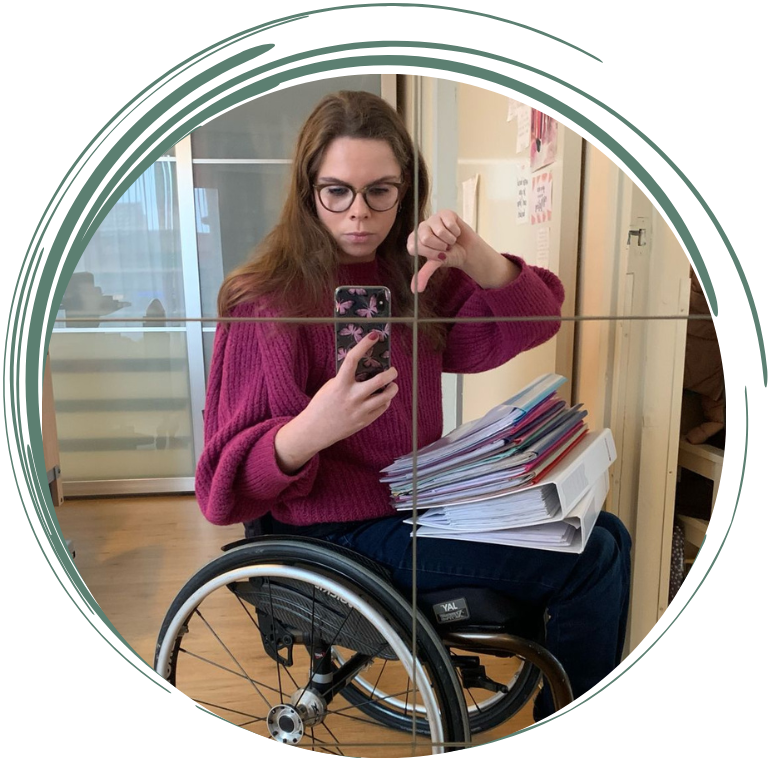
“With good guidance, you don’t throw students into the deep end.”
With her progressive muscle disease, 31-year-old Naomi Vervaart has a positive outlook on life. She prefers to focus on opportunities rather than problems. Still, she has already had to overcome bumps in her (study) career. But she still sometimes feels pushed into a corner. Naomi shared her experiences during the interview with ECIO and gives tips, tops and flops: eye-openers for education professionals and employers.
Due to a rare muscle disease, the muscles from her hips have now failed and Naomi is permanently confined to a wheelchair. “It is a progressive disease that normally only reveals itself later in life, but with me it was clear from birth that I suffer from it. Every year I become a little less mobile.” In her teens, Naomi already knew what she wanted to study. “I was taken by cab to special education for a while. In that cab van there was also a hearing-impaired girl who was learning to communicate with gestures. I liked those gestures so much that I decided to study Dutch Sign Language teacher in Utrecht.”
Extra exam time each year
For her studies, Naomi was able to continue living at home with her parents in an adapted home. “My high school dean pointed me to ECIO for options with my subsequent studies. At my college application, I immediately presented my support needs.” For Naomi, not a lot of adjustments were necessary: space was made for her in one lecture hall because the standard fold-out tables left too little room for her wheelchair. “In addition, I was given more time during exams or allowed to use a laptop because I can’t write very fast.”
“It was not nice that the request for extra exam time had to be requested by letter from the examination board every year.”
Finding internship placement with support needs is an obstacle
It wasn’t until Naomi sought an internship that her support needs did prove to be an obstacle. “I struggled with the question of whether I should mention in my resume that I have a physical disability. I don’t think that’s a problem myself, but I was mainly concerned with practical matters: for example, I can’t apply for a job until I know that the employer’s premises are wheelchair accessible.” Naomi received numerous rejections and did not find an internship placement. “Of course, no one said this was because of my disability, but it was noticeable. I asked for help from the school, but was not properly guided in my questions at this point.” To still get her college credits, Naomi did internships at the college itself. “As a result, I was not able to do the internships I would have liked to do. With one exception; at the Philadelphia Care Foundation. At this organization for people with intellectual disabilities, my disability was logically not an issue.”
According to Naomi, the school did not have a playbook in place to guide students with disabilities to internships. “If you have a disability, you already have to arrange so much. It would make so much difference if the educational institution thinks with you. Because you don’t want to miss an internship; after all, it provides so much in terms of self-development, experiences and insights.”
Good guidance prevents students from being thrown into the ‘deep end’
Because of her disability, Naomi never had time for a side job; the internship was her first experience with applying and working. “As a result, I was thrown into the deep end completely and had to figure out a lot on my own. It would have been nice if my internship supervisors had anticipated this by discussing in advance with employers whether people with disabilities could literally and figuratively find a good place within the company. Everyone talks about inclusion and participation, but then you have to start facilitating it.”
Job applications should be about the candidate and the qualities
For Naomi, the transition to the labor market did go smoothly thanks to the request for help she put out to Emma at Work. “When I graduated, the Participation Act had just come into force. I wanted to work anyway. But mainly by putting my brain to good use. Through a notice board at school I became familiar with Emma at Work: they help young people with disabilities find a job. I contacted them and received very nice guidance. They have many contacts with employers and before a job interview they discuss which disability someone has and what that means for the employer. As a result, the job interview is about what it should be about: the candidate and his/her/their qualities.”
Inclusive employer who puts my qualities first
Naomi was able, in 2015 after graduating, to work as a customer service representative for NS Business through Emma at Work. “Due to my disability, it was not feasible to teach a sign language course in the evenings. The position at NS had nothing to do with my studies, but I gained valuable work experience. NS turned out to be a nice working environment: “I was just Naomi, not that girl in the wheelchair.” After a year, due to a reorganization, the contract was not renewed. “I contacted Emma at Work again. They put me in touch with Nyenrode Business University, where I have been working for almost six years now.” The first five years as program coordinator, now as program advisor EEOD (Executive Education & Organizational Development) and she helps people ask which program best suits their learning needs. “It’s special to work at this beautiful estate. No adjustments are necessary for me; I can adjust the height of the desks myself, we all have laptops and currently work hybrid. Partly at home and partly fine in the office. The building where I work has a disabled toilet and elevator. Not every building on the estate is wheelchair accessible, but that doesn’t hinder me in my work.”
‘From the cabinet to the wall’
Currently, it is not her work where Naomi is experiencing limitations, but she does spend a lot of time dealing with the red tape surrounding her illness. “I work 32 hours a week and get physical therapy three times a week. I hardly get any time to relax. I am not covered by the Long-Term Care Act because I have a certain form of self-direction. This puts me in all kinds of categories: for my aids I have to go to the municipality and the UWV, for domestic help to the municipality, and for nursing and care to the health insurance company. I have opted for a personal budget, because I want to decide for myself who has control over my body. As a result, I have to apply for a new indication every year. That means filling out a lot of forms, making phone calls and sending emails to get that done.”
“Every time I have to tell what my disability means, even though I have lived in the same municipality for 31 years and have had the same health insurance company for years.”
I lost my summer vacation to indication applications!
With the ever-shortening indication deadlines, all those home visits, calls and paperwork take up a lot of Naomi’s time. “I lost my summer vacation to those indication requests! It makes me feel pushed into a corner, because I have to stay physically and mentally healthy. I participate fully, but it feels like the government is making that very thing impossible. Surely it shouldn’t be necessary for me to work one day less to keep time to apply for my indication?” Through social media, Naomi calls attention to this problem. “That makes me see that I’m not the only one struggling with this.”
“There are client support workers and family care brokers who know the laws and rules, but it’s the system that’s flawed.”
I am fighting very hard to resolve this situation. I recently spoke with Jeroen van Wijngaarden, VVD Member of Parliament, and hope that by sharing my story that the issue will get on the political agenda. My wish is one system, with one counter. Also, my heart broke after reading the research that showed that children with disabilities are less positive about their future. I know from experience that this does not have to be the case.”

