
Article | What is inclusive education?
ECIO’s vision of inclusive education


Principles
Inclusive education means that every student feels at home at the university, college or vocational school and a safe study environment is in place. Inclusive education is education that adapts to the student rather than the student adapting to the prevailing system.
Aspects
- Students with and without support needs learn and study together.
- Diversity is seen as the norm. This means that a student population without and with support needs is assumed in advance and that the education is designed accordingly. So that you, as a student with a support need, do not need adaptations or extra facilities. In practice, this means making a building wheelchair accessible in advance, rather than making adjustments when obstacles are experienced.
General accessibility
All parts of the educational system must be accessible to students with support needs. Such as teaching and testing aids, buildings, transportation, opportunities for appropriate study planning, guidance and counseling with course or training offerings, and assistance with transition to internship and/or employment. These are important for a safe and positive learning environment. We focus on
Medical versus social model
In today’s society, we are used to designing our society and education based on how most people are. Persons who deviate from this should adapt as much as possible and receive help to be able to participate as well. For example, at the educational institution where students with disabilities can claim extra help or facilities. So that they can participate in the same way as a student without a disability. For this reason, for example, students with ADHD are often given medication so that they can concentrate in the same way as students without ADHD. Here, people often think from the
UN Convention on Disability
In 2016, the UN Convention was ratified in the Netherlands. Dignity and inclusion are the main focus of the convention. Inclusion means that everyone can participate and contribute to society. That is why the right to education is an important part of the convention. The right to education means starting not from difficulties but from talents and opportunities. With accessibility, personal autonomy and full participation as starting points. ECIO facilitates and supports higher education and secondary vocational education institutions in implementing and securing the objectives of the UN Convention.
Accessibility, personal autonomy, full participation and equality

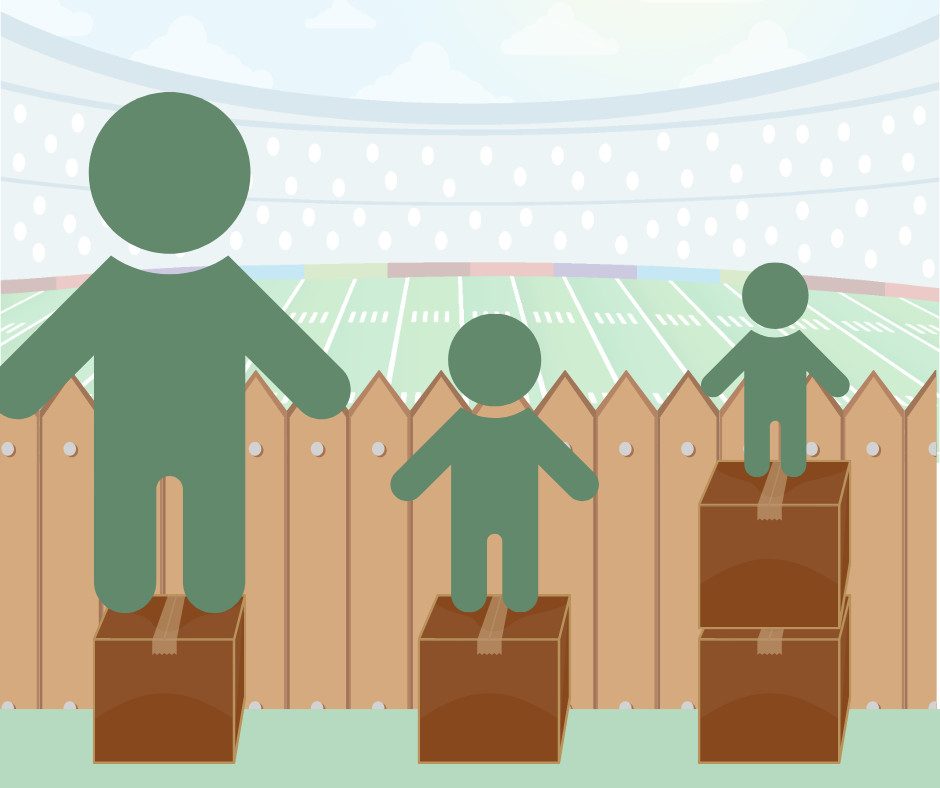
- Figure 1: The assumption is that everyone benefits from the same support: equal treatment.
- Figure 2: Everyone gets the support they need, which produces equity.
- Figure 3: All 3 can see the game without support or adjustments because the cause of the disparity has been addressed. The systemic barrier has been removed.

Making education inclusive is not easy. It requires support throughout the educational institution, knowledge of accessibility and collaboration. A tool in this process is the

