
Student platform | AccessAbility network The Hague University of Applied Sciences
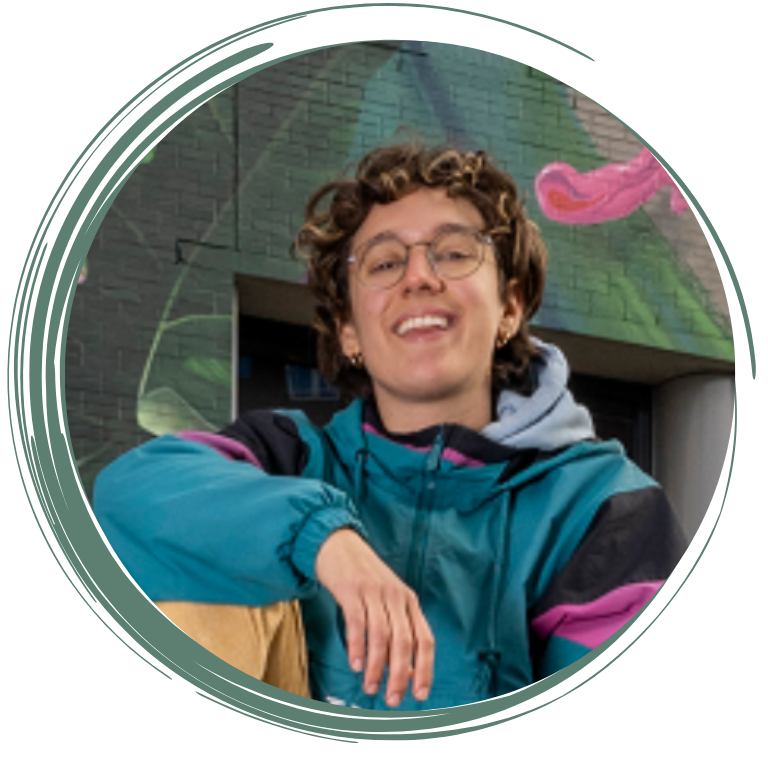
“Our experience helped in setting up the platform.”
Student platforms for and by students with support needs play an essential role in promoting inclusivity and accessibility within educational institutions. Through several interviews with student platforms, we want to provide tools and inspiration to other student platforms, as well as educational institutions, on how to organize student participation within an educational institution.
On October 2, 2023, The Hague University of Applied Sciences affirmed its commitment to promoting inclusive education by signing the Declaration of Intent of the UN Convention on the Rights of Persons with Disabilities. With this, the college is committed to implementing the rights of students with disabilities in higher education.
We traveled to The Hague University of Applied Sciences where we interviewed Eleana Vallianatos, initiator of the student platform.
Part 4: student platform Hague University of Applied Sciences – AccessAbility Network
Fighting for an inclusive world is in Eleana Vallianatos (23)’s blood. As early as high school, Eleana dedicated herself to inclusion. And while studying at TU Delft, this experience was used to found a platform for students with disabilities. And if it is a calling, Eleana is now doing that trick again at the Haagse Hogeschool. Together with fellow student assistant Axell Suryawan, Eleana has worked hard over the past period to establish the student platform. During the Week of Accessibility on Oct. 5, the student platform was officially launched with a lunch.
Last year, at the beginning of his studies in Industrial Product Design, Eleana already wanted to commit to a platform at The Hague University of Applied Sciences, but not on a voluntary basis. When a vacancy for a student assistant for the Inclusion Office came up in March, the ball started rolling.
“Thanks to my previous experience and Axell’s commitment, it was not too difficult to set up a platform again.”- Eleana
“Another positive factor is that The Hague University of Applied Sciences is currently experiencing favorable conditions. Although there have been two staff members dedicated to inclusion for 10 years, a new college president recently took office who has made inclusion her focal point, which has resulted in momentum.”
A safe place
Since the platform is still in formation, the ambitions are not set too high. The idea is to organize regular lunches. Such a lunch has a double purpose. On the one hand, it is an opportunity to gather input from students with disabilities for feedback to the institution. But it is also meant to be a safe place. “We want to provide a platform where you can come to each other, so you don’t feel like you’re on your own when you run into things. In doing so, we chose to house both a platform for students and employees under the same name. There was already an online platform for employees with disabilities. When we started setting up a student platform, we saw no objection to merging both platforms under one name.”
“We think it would be interesting to have the experiences of both groups shared, so that students see that employees are also just people and together you can look for solutions to increase accessibility.” – Eleana
“Meetings with both groups will be organized simultaneously and separately. In online contact, the two groups are separated anyway. So there is also a safe space for the two separate groups. The intention is that the platform will also be open to people who do not yet have an official diagnosis, albeit not just yet. We do think it is important to set conditions, so that no people with bad intentions enter the community and thus disrupt the safe space.”
Huge dip
The importance of understanding each other at an educational institution was something Eleana recently felt firsthand. Eleana has known for five years that she has ADHD and has controlled it through a good lifestyle. In fact, Eleana is proud of it! “I have an enormous drive in coming up with ideas and solutions. In a group, I can keep the atmosphere positive.” But after stopping birth control, Eleana suffered from depression around menstruation. Eleana turned out to have PMDD. “That’s common in women with ADHD,” she said.
This has quite an impact on studying. “I get so hormonally upset by it that I get stressed out and suffer from insomnia. I almost failed my BSA.” Eleana becomes so irritable by it that it affects those around him. “Before I went to the doctor, I showed some people in my immediate circle the symptoms from the DSM5 with the question: do you recognize this in me? And they did! ‘We had two times in the quarter where we didn’t know what was going on with you for a week,’ they said.” That Eleana dared to discuss it at school came mostly from and because of the confidence in the group of students Eleana was working with at the time.
Establishing a platform
“One of the conditions for establishing a platform is that you yourself have a disability,” Eleana said. “Then you have the experiential expertise to see what need there is and you can develop a mission and vision from there. In addition, it is easier to establish a platform if there is attention to the subject from the board of the educational institution. Then there are employees who can help you. You can then also claim services and budget from the institution.”
Both Eleana and colleagues hope to establish a board soon. This will not only give the platform the attention it deserves, as Eleana, Axell and his colleagues also have other responsibilities during their weekly six hours each. This also increases the likelihood that the platform will continue to exist after they all leave.
Learn more
Curious to learn more about the Accessability Network platform? Check out Instagram Accessability Network
The interview series student platforms is written by Thijs de Lange. Thijs de Lange (b. 1997) is a journalist and daytime speaker. He has a mild form of Cerebral Palsy due to lack of oxygen at birth. Since his studies, he has been working as an expert by experience to improve the lives of people with disabilities in the Netherlands. More information can be found on his site: www.thijsdoet.nl.
Tips from the practice of Eleana
Share your knowledge and experiences?

